THE STORY OF BURKE AND HARE
Being a brief account of the regular system of murder carried on in the West Port of Edinburgh between the Christmas of 1827 and October 1828.
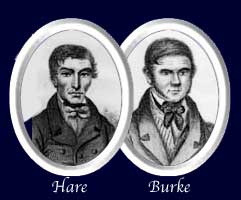
THE principal actor in this wholesale butchery, almost without parallel in any age or country, eclipsing anything in story or romance, was William Burke, a native of Tyrone, in Ireland. Born about the year 1792, of honest, hard-working parents, Roman Catholics, he lived and wrought with them until the age of eighteen, when he left and became a servant to a gentleman in the neighbourhood. After being there about twelve months, the gentleman died; and Burke at the age of nineteen entered the Donegal Militia. At this period he married a respectable young woman in Ballina, and by her had seven children, who all died except one boy, who was alive at the time of the trial. Owing to some dispute he left them and came over to Scotland, where he was employed on making the Union Canal; and met in with a woman named McDougal at the village of Maddiston, in Stirlingshire, where they agreed to live as man and wife. He afterwards came to Edinburgh along with McDougal, and engaged in a sort of petty traffic, travelling about the country selling wares, buying old clothes, and collecting skins, human hair, &c. He also used to purchase quantities of old shoes, and, after cobbling them in the best manner he could, send McDougal to hawk them over the country. They left Edinburgh for a short time, but came back after the harvest of 1827; and then they became acquainted with the monster William Hare, who kept a sort of beggars hotel or lodging-house in Tanners Close, West Port, under the name of Logs Lodging, the previous husband of his wife. In this abode of profligacy, vice, and drunkenness, they carried on their murderous trade, in which they continued for about twelve months.
The first dealing in "subjects" commenced in the following manner in December 1827 a lodger died in his house- a tall, stout man, a pensioner, who led a dissipated, good-for. nothing life, his debauched habits and dropsy combined accounting for his death. His funeral was arranged in a decorous way-coffin procured and guests invited; but instead of the body, there was substituted by Burke and Hare a sackful of tan bark, which was buried with all due solemnity. After the funeral the rogues proceeded to find a purchaser for the body; and at dusk the body was carried by Burke in a sack to Bristo Port: here he rested and changed with Hare, who carried it to its destination- the dissecting rooms of Dr Knox, Surgeons Square, Where they received for it 7 pounds 10 shillings. So much money to such people excited their cupidity; and Burke states that Hare and he talked over the subject of murder, and the best way of doing it. Their first victim was an old woman from Gilmerton, whom Hare noticed a little intoxicated on the streets. Hare accosted her and enticed her to his den, where she was stupefied with drink, and put to death in the manner they afterwards pursued, by covering and pressing upon the nose and mouth. The body was afterwards conveyed to Surgeons Square, where it was readily sold for 10 pounds in December 1827. Their bargain was to receive 8 pounds for each "subject" in the summer session, and 10 pounds in the winter. The next unfortunate victim was an English packman, who came to lodge in the house.
After this a connected account of the other murders cannot be had, as the co-partners kept no books to which reference can be made, and they were not curious regarding the names of their victims, &c. They in all amounted to sixteen: 1st, the old woman from Gilmerton; 2nd, the English peddler; 3rd, an old man, Joe the Miller; 4th and 5th, Mary Haldane and her daughter; 6th and 7th, an old Irishwoman and her grandson; 8th, a cinder-gatherer; 9th, an old woman taken out of the hands of the police officers; 10th, Mary Patterson; 11th, a woman from the country; 12th, the girl McDougal; 13th, Mrs. Osler or Hosler, the washerwoman; 14th, "Daft Jamie"; 15th, a girl murdered by Hare alone; 16th, the woman Campbell or Docherty, which was the last murder committed, and which proved the cause of their detection by an Irish lodger called Gray and his wife, who in looking for a stocking noticed the body lying beneath the bed covered with straw. On giving information they were arrested, Burke and his paramour McDougal, and Hare and his wife. Before the trial, an offer was made to Hare, that if he would give evidence he would be allowed his freedom, which he gladly agreed to. The day fixed for the trial was 24 December 1828, at the High Court of Justiciary, Edinburgh, at which Burke was condemned by the evidence of Hare; his wife and Helen McDougal being liberated. Their trial created the utmost sensation; and the Court and Parliament Square were mobbed. At the execution of Burke, which took place on Wednesday 28th January 1829, it was estimated that there were between thirty-two and forty thousand people. Amidst the yells of this vast mob, some shouting "he would see Daft Jamie soon," &c, he paid the last penalty of the law at the top of Libertons Wynd, almost within sight of where they had carried on their butchery.
It was a scene (writes one) never to be forgotten, the execution, and the great mass of people who had assembled from all parts, and had stood, as was the case with many of them, from two and three in the morning in the plashing rain-for it rained the whole night, but cleared up a little before the execution, though still very cold. It was like a great holiday; more like a thing of joy than an execution. Not only the class of people who generally attend such things were there, but respectable ladies, in their gay dresses, were seen in some of the windows, which added to the picturesque effect; and long, long before the execution, the whole place in the vicinity of the scaffold was packed, and seemed too small for the crush. The Lawnmarket, High Street, County Buildings, and the Bow were one mass of what seemed to be solid with life. At all the windows, any jutting piece of a building, roof tops, and the smallest niche where they could climb to, there human beings had fixed themselves. One thing which must have struck any one was the absence of any kind of sympathy with the condemned; instead of that, it was more akin to joy, breaking out every now and then. When the workmen finished the scaffold, after working all night, there was such a cheer, raised by the people that it was heard for miles round at the furthest end of Princes Street, and all around long distances. It is usual after an execution, for the people to hurry away as if half ashamed of being there, or as if they were glad to get off-a feeling of relief, a sort of queer, strange feeling of terror. Not so here; but a feeling of Sweet revenge or justice seemed to have taken possession of the onlookers, and when the clock of St Giles rolled forth the death-knell of Eight, the time of execution, all was hushed, but only for a little, until Burke made his appearance with Williams the executioner, and his confessor (for he professed the Catholic religion). Then, as noticed before, they greeted him with cries and shouts. After the execution, the body was cut down and given by the Town Council to Professor Munro, in the College, for dissection for the instruction of his students, to the knife, where he had sent many a poor victim before. Such is the Nemesis that follows crime. All the day (Wednesday) dense mobs crowded round the College Buildings, and knots of people went listlessly through the streets, as if justice was only half done. A universal discontent reigned for allowing Hare to get off scot-free.
It was thought by some that the mob might try to get hold of the body of Burke. So for safety it was removed from the Dead House to the dissecting-room, and early on Thursday morning many famous scientific men called to have a glimpse of the body previous to the students crushing in, such as Sir W. Hamilton, George Combe, the famous phrenologist; Mr. Linton, Dr. Christison, and others. Some made sketches of the body. Then the stream of students poured in, and the body became the subject of lecture, his head being sawed across to illustrate the lecture, which was on the brain. All was decorum in the classroom; but outside the College Yard, there had gathered a lot of young students not belonging to the Anatomy Class, and other young men, who began to clamor for admittance. To quell the disturbance, the police were sent for, which only helped to make things worse. Students have always shown impatience of being forcibly put down by the police, and a regular melee took place in which some of the police were worsted, and used their batons freely. The mob then began to smash the windows of the dissecting-room. Some of the students were captured by the police, but were as quickly recaptured, amidst the shouts of their companions. At last, after the intervention of some of the Town Counci1 and Dr. Christison (who had arranged that permission would be granted to them to see the body of Burke in companies of fifty at a time), the disturbance was quelled at once, and turned into cheers. But it did not end here; for the people outside the College Yard Gate were more inflamed to gaze on the corpse of Burke, and bearing of the success of the students only stirred up to fresh efforts to gain admittance. They also threatened that they would force in, and at last it was arranged that on the following day (Friday) the body would become a public exhibition. The public came in at one door and, passing the corpse of the hanged man, passed out at another. A strange spectacle, ever to be remembered in the annals of crime! There Burke Lay on the black marble table of the dissecting-room: naked, horrible, exposed to the gaze of a living stream of his fellow men who passed at the rate, it was alleged, of sixty persons per minute After this unheard-of exhibition, the body was cut up for dissection.*
But what of Hare, who, it was said, was the worst who first led Burke on, and then gained his freedom by turning Kings evidence on his fellow ruffian, showing the old proverb, "Honour among thieves," to be untrue? It was attempted to bring a second case against him, by Mrs. Wilson, the mother of Daft Jamie and a second indictment was brought in, with the intention of convicting Hare. But, after a great discussion, it was thrown out, and Hare declared at liberty, if it could be so called, as it was said that he would be torn to pieces by the people if seen, such was the feeling his conduct had called forth among a peace-loving people. To get free, perhaps, to play the same part over again! How would he live? What would he do? Were the questions asked. Hare himself could not answer them; but he was anxious to get away, yet afraid to venture. At last, under the name of Mr. Black (not an inappropriate name for him), he was escorted from his cell in the Calton Jail late on Thursday night, after the decision of the judges, on a cold, sleety night in the month of February, to the Old Post Office, Waterloo Bridge, where he was put into the mail-coach for Dumfries, to get into England, where he would not be known, and wander, like Cain, till forgotten. Little more was ever heard authentically of Hare. There has been a great deal of surmise what became of him.
There remains now very little to be told regarding the others. Mrs. Hare, on being liberated, barely escaped the rage of the mob, but eventually reached Glasgow, where she embarked to her native country, Ireland, in the Clyde steam-ship Fingal, to become a wanderer on the earth. Little trace was got of McDougal. After getting her release, she repaired to her old haunts in the West Port. She was at once recognised and mobbed, and it was only by escaping by a ladder placed against a back window of the house she got off. She afterwards turned up in the village of Redding, Stirlingshire, but disappeared, and is alleged was burnt to death in a house that took fire in New South Wales. Such is the destiny which seems to follow crime, even in this world.
* Some of the students, it was alleged, slipped away pieces of the skin, and got them tanned. In 1882 we had in our possession a pocket-book which was of it. It was dark, and just like leather. It was sold to one of the professors, who, we understand, made a present of it to the Anatomical Museum, New University. It had stamped in gold on it "Burkes Skin, 1829".
W SMITH (1829)